Building Blocks for Competitiveness in 2017

Over the last six years, we have tracked the country’s competitiveness ranking across a series of global competitiveness reports to see how we compare against other countries.

Liveable cities

Published on December 31, 2016

Over the last six years, we have tracked the country’s competitiveness ranking across a series of global competitiveness reports to see how we compare against other countries. These reports range from well-known ones like the World Economic Forum’s Global Competitiveness Index, the World Bank-IFC’s Ease of Doing Business Report, Transparency International’s Corruption Perceptions Index, and the Heritage Foundation’s Economic Freedom Index to the less well-known like the Failed States Index and Logistics Performance Index.

When many of these reports were first established, some of them as far back as the 1990s, the Philippines ranked deep in the bottom 20% of world rankings. Even as recently as 2011, we ranked in the bottom 30% of virtually all major reports, with the only exception I know being the Gender Gap Report (where we currently rank 7th in the world).  Our modest goal in 2011 was to move the country into the top-third of world tables.

Looking back at our performance and the annual data releases, we have indeed improved – but we haven’t made it into the top-third yet. We have managed, though, to get out of the bottom 30% and move into the middle-third for most of these indices.  Our performance in 2016 indicates continuous improvement across most indices, though not all.

Being more competitive essentially makes the country more attractive for investments and new business generation. Most countries which rank higher than us in the region generate much more direct investments than we do, sometimes five or six times as much.

In order for us to create a business-friendly environment, we need to focus on a number of themes: process improvement, local governments, and regulatory reforms, among others. We are basically trying to build a competitive structure on these foundations.

In the area of process improvement, our Ease of Doing Business project works with agencies to smoothen out business transactions with government such as incorporation, land registry, obtaining permits, and other common business transactions. Our goal is to simplify and streamline these procedures and to eventually automate them so people can transact with government online. Anybody who has had to obtain a permit knows how much trouble and inconvenience any process has been. We need to automate. Working with new agencies such as DICT and others, we should see some new projects roll out early in 2017.

We believe that local competitiveness is a building block of national competitiveness. Thus, we have expanded our Cities/Municipalities Competitiveness Index to now cover almost 1,400 LGUs across the country in just four years. This index measures local government performance in the economy, infrastructure, and governance. In 2017, we will add a fourth criterion and set of indicators on resilience and sustainability. Our experience with typhoons and storms, including the latest Typhoon Nock-Ten (Nina) which hit on Christmas Day, tells us that this is so necessary.

Our newest project is focused on regulatory reform. Project Repeal targets outdated rules and regulations which no longer serve their purpose or are no longer necessary (or are even detrimental) for the economy. Over 80 executive agencies have signed on and submitted almost 35,000 rules for review. After some review, 4,839 have been repealed. We expect this pace and breadth to grow. Our next steps include learning how to cost out the savings generated through a standard cost model as well as expansion into reviewing laws in Congress and Local Government Units.

Aside from these projects, certain policy reforms will also form part of investor expectations for the upcoming year. These reforms would include the proposed tax reform program and the lifting of restrictions on foreign investments through the easing of the Foreign Investment Negative List. On the part of the National Competitiveness Council, other legislative reforms we are looking forward to (and closely working on with Congress) are the amendment of the Corporation Code and the passage of the Ease of Doing Business Act.


It’s going to be a busy 2017.


Guillermo M. Luz (gm.luz@competitive.org.ph) is the Private Sector Co-Chairman of the National Competitiveness Council.

Private, Public schools ask LGUs to provide connectivity

Both private and public schools urged the local government units (LGUs) to provide them with connectivity and internet access to boost the online learning requirements of their students as the education sector prepares for the new normal when school resumes next month.

Liveable cities

Published on July 23, 2020

Both private and public schools urged the local government units (LGUs) to provide them with connectivity and internet access to boost the online learning requirements of their students as the education sector prepares for the new normal when school resumes next month.

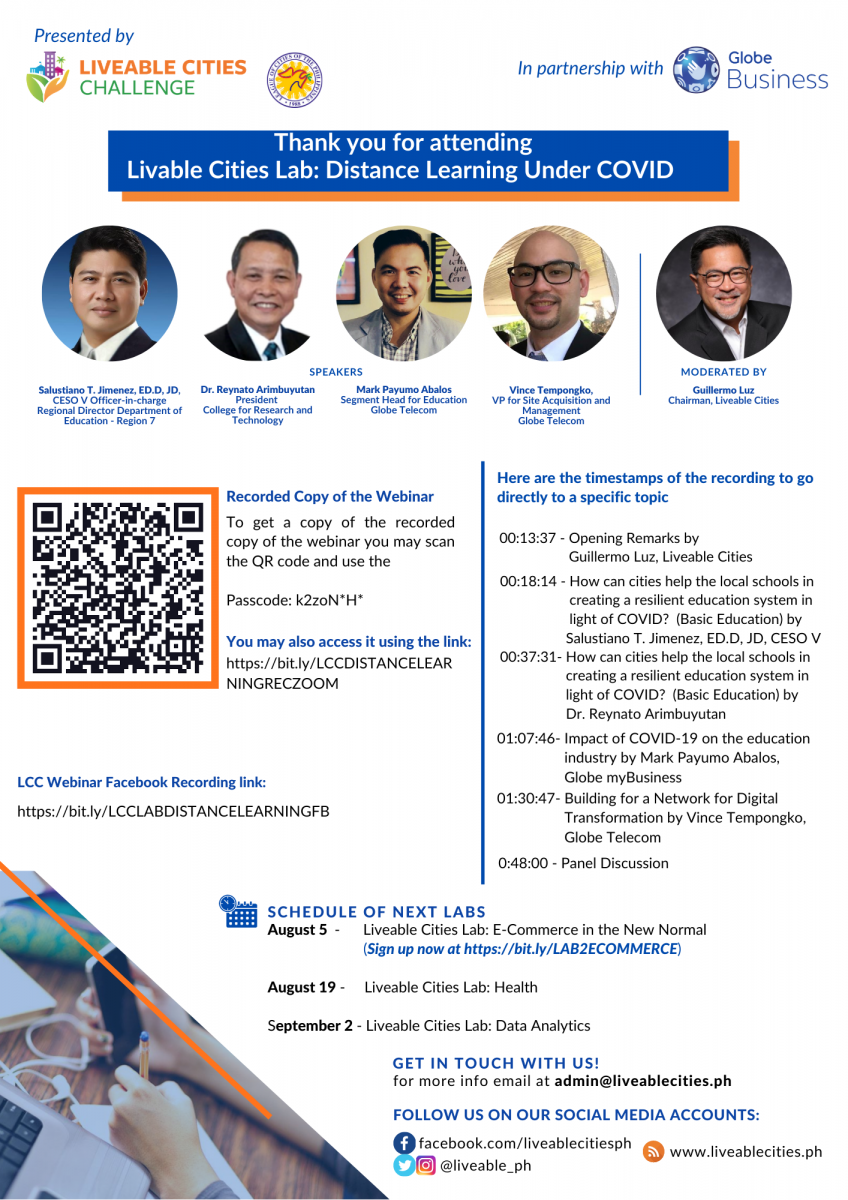
The request highlighted the opening session of the Liveable Cities Labs:  Webinar Series on the topic, "Online Education Under COVID" that was organized by the Liveable Cities Challenge (LCC),  the League of Cities of the Philippines and Globe Business.

Dr. Salustiano Jimenez, acting Director of Region VII of the Department of Education (DepEd), opened the discussion by presenting the current situation of public schools in Central Visayas. Dr. Jimenez said that due to the COVID-19 pandemic, DepEd needs to adjust to new teaching modalities to suit learners, which include modular, online or distance learning, self-learning, blended learning, and homeschooling.  The DepEd urged the LGUs, especially the cities and municipalities, to help create a resilient educational system.

“Aside from giving out tablets and phones, they can help by providing access or connectivity with point to point connection and a wide area network to connect the students and teachers,” Jimenez said.

Dr. Reynato Alimbuyutan of the National Research College in Nueva Ecija echoed Jimenez’s call to the LGUs to ensure that connectivity is assured once schools open on August 24, 2020.

“Support should be given to private schools because we are experiencing the brunt of the pandemic, too. LGUs can help provide internet access because we no longer have the means to do this,” Alimbuyutan explained. 

According to DepEd, only 27 percent of private school students have enrolled back in private institutions, compared to last year, resulting in loss of income and closure of some of these schools.

Due to the pandemic, there is a demand for online learning as DepEd prepares its Basic Education Learning continuity plan that includes allowing schools to decide the use of learning methods depending on the situation where the schools are located. Globe supports these adaptive learning methods, especially online learning that has shown increased retention of information among students,  in the new normal.

“The pandemic has really disrupted education not only in the country but the whole world as well. But rest assured that we are in this together, we are with the education sector in finding ways to help overcome these challenges,” Mark Abalos, Globe Segment Head for Education, said.

Of the 28 million Filipino students, more than nine million are in the secondary level, while more than 8 million are in the primary level, with the rest on pre-primary and tertiary levels.

For its part, Globe said its infrastructure expansion program for the rest of the year remains on track despite the mandated quarantine restrictions. Vince Tempongko, Globe’s VP for Site Acquisition and Management, assured that the company’s network builds nationwide include areas near schools, colleges, and universities. Globe, however, needs the support of the LGUs to fast-track the infrastructure build-up.

“We can do this as soon as the LGUs give us the necessary permits so that we have a pipeline of sites for construction so that Globe can increase its capacity now that connectivity is an essential tool for our students in the new normal,” added Tempongko.

Moderated by LCC Chair Guillermo Luz, the Liveable Cities Lab will be held every other Wednesday in the next seven weeks. The series will feature topics to equip city leaders and stakeholders with knowledge and insights to help them best serve their communities. 

More than 400 participants, including at least 20 mayors coming from different areas of the country, attended the webinar.


Health: Endcov.ph Flattening the curve with the help of data

In mid-March, the country was put into an Enhanced Community quarantine (ECQ). Over time, different parts of the country were declared under Modified Community Quarantine (MECQ) or General Community Quarantine (GCQ). By June 1st, most of the country shifted to GCQ. The shift to GCQ, however, doesn’t mean that the danger of infection has passed. We still need to remain vigilant.  

Liveable cities

Published on June 9, 2020


In mid-March, the country was put into an Enhanced Community quarantine (ECQ). Over time, different parts of the country were declared under Modified Community Quarantine (MECQ) or General Community Quarantine (GCQ). By June 1st, most of the country shifted to GCQ. The shift to GCQ, however, doesn’t mean that the danger of infection has passed. We still need to remain vigilant.  

In light of community quarantine still, in place where people are still required to stay at home,  technology and data can play a big role in combating this pandemic. Technology makes it possible to track the spread of COVID-19 across the country, down to Cities and Municipalities. Such data will help national and local decision-makers make the right public policy decisions to help manage this pandemic.

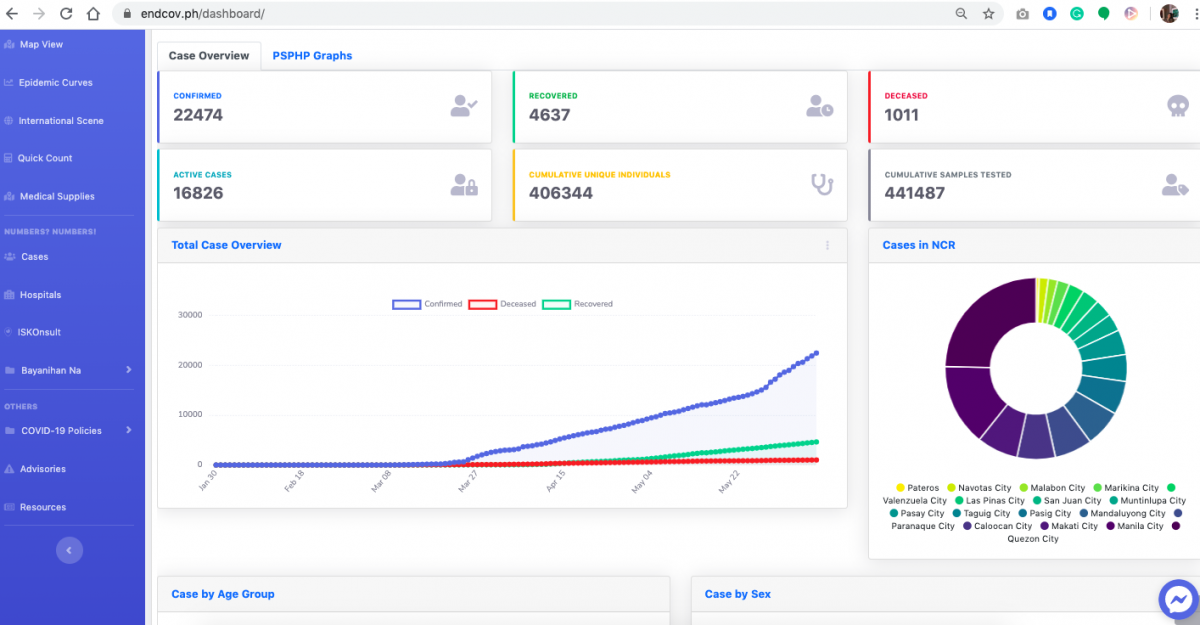
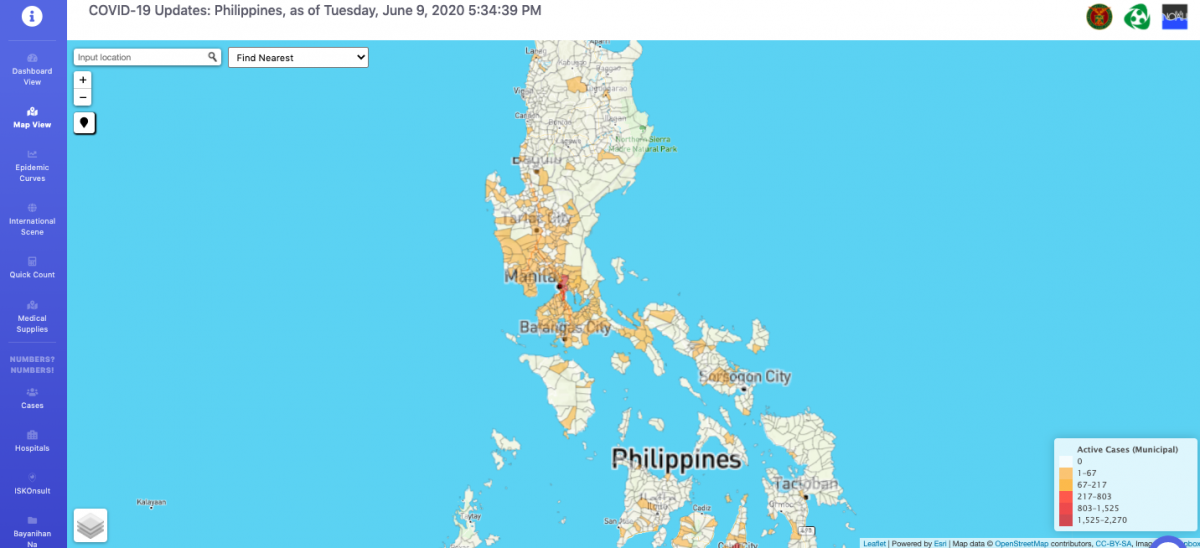
The University of the Philippines Resilience Institute (UPRI), in collaboration with the UP Nationwide Operational Assessment of Hazards (NOAH), has developed a dashboard that tracks the spread of COVID-19 in the Philippines called ENDCOV PH (http://endcov.ph/). The website aims to provide people with information for tracking the number of confirmed COVID-19 cases, recovered patients, deaths, patients under investigation (PUI, now called Suspects) and persons under monitoring (PUM, now referred to as Probables). 

Endcov.ph features an easy-to-use map and uses a color-coded “heat map” which shows localized areas that have the most (darker areas) and the least (brighter areas) number of confirmed COVID-19 cases.

In order to ramp up data gathering, endcov.ph encourages submissions from Local Government Units. The endcov.ph dashboard also contains information such as a directory of hospitals all over the country, announcements and advisories from the Department of Health and World Health Organization, links for donations, and other resources on health, education, economic support, and mobility policies.

The website can be accessed using this link: http://www.endcov.ph     


Mobility: The Public Transit Challenge under GCQ

As Metro Manila goes into General Community Quarantine starting June 1, the key question will be “will there be enough transportation or mobility options”? As people return to work, will there be enough public transport?

Granted while not everybody will be returning to work – only certain industries and essential services will be allowed to re-start – the answer will nonetheless be No.

Liveable cities

Published on June 2, 2020

As Metro Manila goes into General Community Quarantine starting June 1, the key question will be “will there be enough transportation or mobility options”? As people return to work, will there be enough public transport?

Granted while not everybody will be returning to work – only certain industries and essential services will be allowed to re-start – the answer will nonetheless be No.

Assuming you don’t drive to work in your own car or motorcycle or you live within bicycling and walking distance to work, how long will wait times be? How long will a trip take? How long will each passenger be exposed to risk? We will find out tomorrow.

The public transport options will be extremely limited under GCQ.

LRT-1, LRT-2, MRT-3, and PNR will run but will be limited to 10% to 20% of their capacity. Some buses will run to augment Rail along their routes but will carry only 50% of their normal seating capacity. The rest of the buses will only be allowed to run after June 22. Taxis and ride-hailing services (Grab) will be allowed to run as will tricycles, but all with reduced numbers of passengers. Jeepneys and UV expresses will not be allowed back until after June 22. Motorcycle taxis (Angkas) will not be allowed under GCQ.

The quick back-of-the-envelope calculation of total capacity for Taxis, Ride-Hail Cars (Grab), Buses, and Tricycles for June 1-22 is 1.3 million passengers, one-way. LRT’s 1 and 2, MRT-3, and PNR will add approximately 63,300 seats, per way, as their capacity will be limited to 10% to 20% of normal loads.

After June 22, when you add Jeepneys and UV Expresses to Taxis, Ride-Hail Cars, Buses, and Tricycles, LRT1, LRT2, MRT3, and PNR, the public transit capacity will grow to just under 3.3 million passengers per-way.

Contrast that with the 7.3 million passengers, per way, which the public transit system can carry on EDSA and major Radial and Circumferential Roads in the pre-COVID period, including LRTs 1 and 2, MRT-3, and PNR. The rest of the people ride private vehicles like cars, motorcycles, bicycles, and e-scooters, or walk.

Hopefully, this challenge will force us to re-think and re-imagine our mass transit system. Another subject for another time. In the meantime, get ready for the mass transit challenge.

GCQ will open up some businesses but getting workers and customers to come in remains to be seen.


Download

Dassault Systemes’ 3D Design and Project Management Tools for Cities

University and college students are invited to participate in the Liveable Cities Challenge by joining cities that have signed up for the design challenge and competition. In order to enable the cities in planning and designing their solutions for the Liveable Cities Challenge, Dassault Systemes will be providing design and project management software to students who agree to join city teams.

Liveable cities

Published on February 11, 2020

University and college students are invited to participate in the Liveable Cities Challenge by joining cities that have signed up for the design challenge and competition. In order to enable the cities in planning and designing their solutions for the Liveable Cities Challenge, Dassault Systemes will be providing design and project management software to students who agree to join city teams.

The 3DEXPERIENCE platform is a world-class industry innovation and business platform. It provides software solutions from planning to design to engineering which can help in the creation process and user experiences. It provides access to a catalogue of applications that allow you to design, simulate, inform, and collaborate on a project. With a single, easy-to-use interface, it powers industry solution experience, based on 3D design, analysis, simulation, and intelligence software in a collaborative interactive environment. 

By participating in the Liveable Cities Challenge, university student teams can obtain free access to the 3DEXPERIENCE free of charge. The software is an ideal collaboration tool for Schools/Colleges of Architecture, Engineering, and Urban Planning and other related fields.

To sign up for the challenge, please fill out the downloadable form (http://bit.ly/LCCPH2020Academe) and submit it back to the Liveable Cities Challenge: admin@liveablecities.ph. Upon registration, the university/college point-person will need to submit the names and contact information for individual student team members.

Registration is now open until Feb 15, 2020.

What is the 3DExperience platform? (fun video)


Contact Us Form

CAPTCHA
This question is for testing whether or not you are a human visitor and to prevent automated spam submissions.

Mayors, private sector representatives gather together to make PH cities liveable

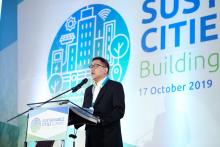
'INVESTMENT opportunities linked to the SDGs are predicted to grow exponentially ahead of other sectors. In the Philippines, the size of the prize is at least $82 billion and 4.4 million jobs by 2030,' Systemiq senior advisor Gail Klintworth said during the "Sustainable Cities Summit: Building Liveable Cities

Liveable cities

Published on October 25, 2019

'INVESTMENT opportunities linked to the SDGs are predicted to grow exponentially ahead of other sectors. In the Philippines, the size of the prize is at least $82 billion and 4.4 million jobs by 2030,' Systemiq senior advisor Gail Klintworth said during the "Sustainable Cities Summit: Building Liveable Cities

Technology important in improving governance — Mayor Binay

The importance of technology in improving governance and bringing officials closer to their constituents were underscored by Makati City Mayor Abigail “Abby” during a forum, Thursday. “I believe that leaders should adapt to the digital age and conceptualize innovative ways to make public services more accessible to our people,” she said in her..

Liveable cities

Published on October 18, 2019

The importance of technology in improving governance and bringing officials closer to their constituents were underscored by Makati City Mayor Abigail “Abby” during a forum, Thursday. “I believe that leaders should adapt to the digital age and conceptualize innovative ways to make public services more accessible to our people,” she said in her..

Liveable Cities Challenge Launch

We are pleased to announce the launching of the Liveable Cities Challenge. The Challenge is a series of competitions among cities to see who can design the best solutions to address a specific problem or "pain point" of their city. This first Challenge is a design competition covering four selected aspects essential to building sustainable, resilient, and competitive cities: Mobility, Resilience, GovTech, and Basic Services.

Liveable cities

Published on October 16, 2019

We are pleased to announce the launching of the Liveable Cities Challenge. The Challenge is a series of competitions among cities to see who can design the best solutions to address a specific problem or "pain point" of their city. This first Challenge is a design competition covering four selected aspects essential to building sustainable, resilient, and competitive cities: Mobility, Resilience, GovTech, and Basic Services.

The Liveable Cities Challenge is open to all 145 Highly-Urbanized and Component Cities in the Philippines. Cities may choose to compete in more than one category by submitting different entries.

The Challenge will run for 90 days from November 2019 to end-January 2020. Entries will be reviewed by a Screening Committee and shortlisted for presentations and pitches to a Board of Judges in February 2020.

To assist cities competing in the Challenge, a pool of Mentors from industry and professional experts will be made available to provide advise and coaching. Design tools will also be made available to universities which form part of city teams in the competition.

Labs and workshops will also be conducted to provide more technical assistance for cities.

We are now receiving applications up to 30 October 2019.

We look forward to having your city join the Liveable Cities Challenge as we work together to create sustainable, resilient, and competitive Liveable Cities.

Download

Liveable cities

The Philippines has had a spotty record of urban planning. What started out as beautifully master-planned cities generations ago have ended up as cities characterized by congestion and traffic, little or poor access to mass transit, few open spaces, parks and public spaces, and many blighted and derelict sections. And yet we’ve also seen some areas beautifully planned and built out in different parts of the country.

Liveable cities

Published on January 19, 2019

The Philippines has had a spotty record of urban planning. What started out as beautifully master-planned cities generations ago have ended up as cities characterized by congestion and traffic, little or poor access to mass transit, few open spaces, parks and public spaces, and many blighted and derelict sections. And yet we’ve also seen some areas beautifully planned and built out in different parts of the country. Whether by design or accident, the parts that have become “liveable” are thriving, booming and driving growth.

Cities are drivers of economic growth and innovation. They are hubs of consumption, resource use and waste. They are also generators of wealth, production and development. The world has been on an urbanization trend for some time now. Over 80 percent of global GDP is generated in cities; 70 percent of greenhouse gas emissions come from cities as well. Over one-half of the people in the world live in cities. And over 30 percent of global city residents live in slums; 75 percent of the global urban population live in a developing country.

For the Philippines, one of the keys to building our national competitiveness is to build city competitiveness. With a population of 105 million people scattered across an archipelago, we need to build liveable cities beyond our three traditional major metropolitan areas of Manila, Cebu and Davao. We need to build 40 to 50 liveable cities.

There are many elements of “liveability,” but in meetings and surveys with mayors, we’ve narrowed down some initial elements to four basic characteristics: Connectivity/Mobility; Resilience; GovTech; and Basic Services.

Connectivity/Mobility would refer to the ability to digitally connect and to move people, goods and services within a city and across cities and the country. Without this, commerce and trade would not be able to grow. This would also include mass transit and other forms of mobility such as pedestrianization, bike-ability and PWD access.

Resilience would refer to a city’s ability to manage itself, prepare and recover in the face of natural calamities, manmade disasters and accidents. Given that we live in a climate-defined future, this will continue to be a major concern for Philippine cities.

GovTech would refer to the digitization of municipal services from both the frontline services and city management points of view. Because most municipal permits (e.g., mayor’s permit, construction permits, occupancy permits, etc.) are still manually applied for and issued, an obvious area of improvement for cities would be to digitize and make these licenses and permits available online, preferably over a smartphone. Moreover, a movement toward “intelligent cities” should lead to improvement in the delivery of services and management of a city.

Finally, Basic Services would refer to such items as power, water, sewerage, telecommunications and other utilities and basic services without which a city could not be considered liveable.

For these reasons, we have established the Liveable Cities Challenge project, to work with city mayors, administrators and planners as well as the private sector to focus on these elements to make cities more sustainable, resilient and competitive. The project will organize Liveable Cities labs, an annual summit, online academy, city dashboards, as well as design, finance and implementation challenges for Philippine cities.

Building liveable cities will bring a number of benefits for cities and the country. The presence of sustainable, resilient and competitive cities creates more potential investment destinations in the country. This, in turn, generates new job opportunities and creates wealth in cities, providing the potential to grow the middle class and to spur more inclusive growth. At the end of the day, it distributes opportunity for growth across the country and provides investors with more options than we currently

Guillermo M. Luz (luz.gm@ayala.com.ph) is an associate director at Ayala Corp. and served as cochair of the National Competitiveness Council from 2011 to 2018. @inquirerdotnet

Watch Our Liveable Cities Labs

Watch Now